
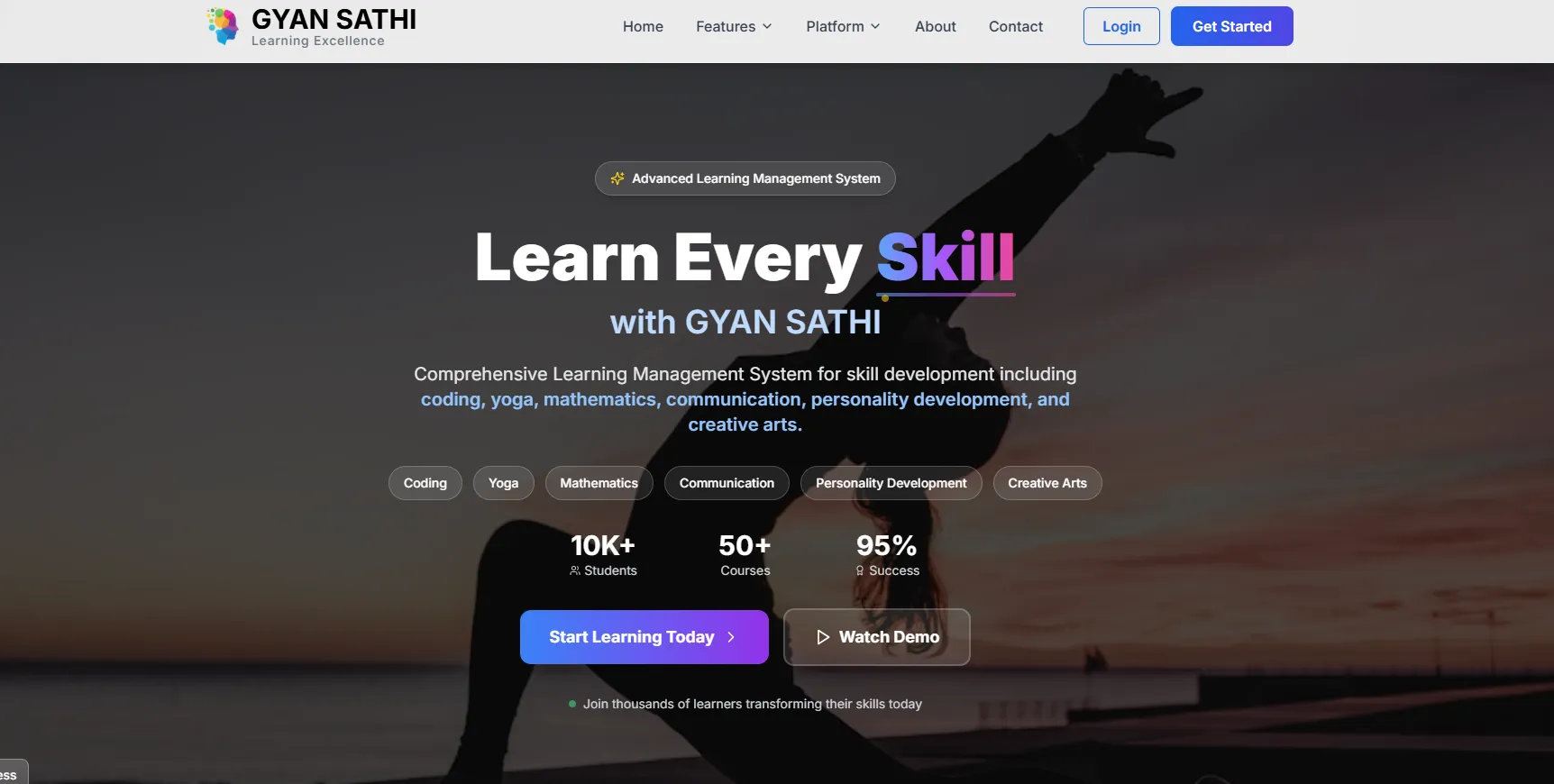
Gyansathi Case Study — Rebuilding an Education Portal for Speed, Scale and SEO
How SocialFly Networks rebuilt Gyansathi from a slow legacy stack into a fast, SEO-friendly Next.js education portal — the architecture, performance gains, organic traffic outcomes, and the lessons that apply to any EdTech rebuild.
Gyansathi is a learning portal for students and parents. When the founders came to SocialFly Networks, the platform was working — but slow, hard to extend, and effectively invisible in organic search. This case study walks through how we rebuilt it: the architecture decisions, the performance work, and the SEO outcomes. The same playbook applies to most EdTech web development projects.
The starting point
The legacy stack was a mix of server-rendered PHP for content pages and a separate dashboard built on a heavy SPA. Symptoms:
- LCP > 5s on mobile on category pages and the homepage.
- No structured data, no canonical management, no sitemap.
- Two different stacks serving overlapping URLs — every change required two deploys.
- Content team blocked on engineering for the smallest copy edits.
Architecture — what we changed
One stack, App Router
We consolidated onto Next.js (App Router) for both the marketing/content surface and the student dashboard. Server components render everything that needs to be indexable; client components handle interactive learning surfaces.
Content split: CMS for marketing, Postgres for product
Marketing pages, course descriptions and SEO content moved into a headless CMS so the content team can ship without engineering. Product data — students, attendance, assessments — sits in a Postgres + Prisma stack.
Caching tiers
- Edge cache for marketing pages (revalidated on CMS publish).
- ISR for course detail pages.
- HTTP cache + tag-based invalidation for product reads.
Observability from day one
We instrumented Web Vitals on real users, server-side request logs, and synthetic checks on the critical user journeys. The first two weeks of production told us more than three months of staging would have.
Performance work
The big LCP wins came from a small list of changes:
- Hero images served via
next/imagewithpriority+ AVIF, sized for the actual viewport. - Self-hosted variable fonts via
next/fontwithdisplay: swap. - Third-party tags (analytics, intercom) deferred behind
strategy="lazyOnload". - Above-the-fold sections rendered server-side; below-the-fold dynamically imported.
- Critical CSS inlined; the rest streamed.
End-state: LCP under 2 seconds on mid-tier Android over 4G for 90% of pages. CLS effectively zero.
SEO work
Most of the SEO gain came from boring, foundational fixes:
- Per-route titles and descriptions — no more page templates with the same metadata.
- Course, FAQPage, BreadcrumbList JSON-LD on every detail page.
- A real
sitemap.tscovering categories, courses and articles, regenerated nightly. - Internal linking from articles into related courses and from courses back to category pillars.
- Canonical URLs that actually match the served URL (a surprisingly common bug).
Outcomes
In the six months after launch:
- Organic traffic up materially across course and article pages, with the largest gains on long-tail "how to" queries.
- Bounce rate down on category pages — a knock-on effect of LCP and content quality.
- Engineering throughput up — the content team ships independently, and product engineers spend their time on learning features instead of marketing copy fixes.
What we'd do differently
- Move analytics off the main thread sooner — we left it on
afterInteractivefor a few weeks longer than we should have. - Get the CMS schema right before importing legacy content. Schema migrations on production content are painful.
- Treat sitemap and robots as code, not config — they belong in version control with a test.
Takeaways for any EdTech rebuild
- One stack beats two — even if it costs you a quarter of consolidation work.
- Performance is an SEO feature. Don't ship the rebrand without LCP under 2.5s.
- Content people should not be blocked on engineering. Headless CMS, every time.
- Structured data is high-leverage and low-cost. Ship it on day one.
If you're planning a similar rebuild, our web development team has shipped this pattern across education, SaaS and ecommerce. Book a discovery call to talk through your stack.
Frequently Asked Questions
What stack was Gyansathi rebuilt on?
Next.js (App Router) for both the marketing surface and the student dashboard, with a headless CMS for marketing content and Postgres + Prisma for product data. Hosting is on a Vercel-style edge runtime with tag-based cache invalidation.
How did the rebuild affect SEO?
Organic traffic increased materially in the six months after launch, driven by per-route metadata, structured data (Course, FAQPage, BreadcrumbList), a proper sitemap, and major LCP improvements. The biggest gains were on long-tail informational queries.
Is this approach overkill for a small EdTech?
No. Even a single-school portal benefits from server-rendered content, a headless CMS so non-engineers can ship copy, and basic structured data. The architecture scales down as well as it scales up — you can ship a small version of the same playbook in a few weeks.
Can SocialFly Networks build something similar for our institute?
Yes. We build custom EdTech portals, school management systems and learning platforms end-to-end. We also offer EduFly ERP for schools and coaching institutes if you'd prefer an off-the-shelf product. Get in touch for a tailored proposal.